
Regulation (EU) 2024/1860 extended the transition periods of the EU In Vitro Diagnostic Medical Devices Regulation (IVDR, Regulation (EU) 2017/746) for legacy devices. This article summarises the new deadlines, the conditions and what manufacturers need to do.
1. Extended transition timeline
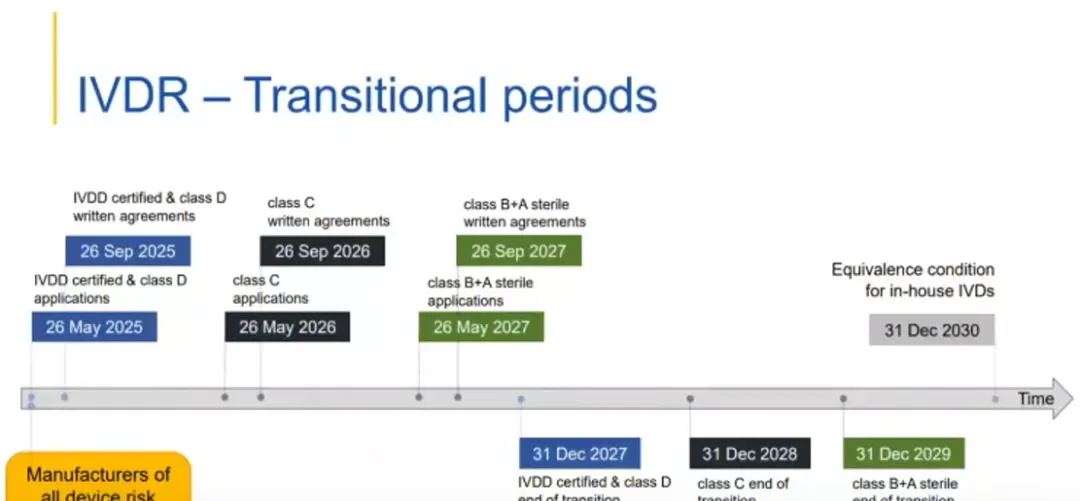
| Device class | Transition period ends | Apply to a notified body by | Written agreement signed by |
|---|---|---|---|
| Class D | 31 December 2027 | 26 May 2025 | 26 September 2025 |
| Class C | 31 December 2028 | 26 May 2026 | 26 September 2026 |
| Class B and class A sterile | 31 December 2029 | 26 May 2027 | 26 September 2027 |
2. Scope and conditions
2.1 Legacy devices only
- Devices with a valid certificate or declaration of conformity under the former IVD Directive (IVDD 98/79/EC).
- New devices are not covered: IVDs placed on the market for the first time must comply with the IVDR directly.
2.2 Conditions
- No significant changes to the design or intended purpose of the device.
- The device does not present an unacceptable risk to health or safety.
- By 26 May 2025, the manufacturer has put in place a quality management system (QMS) in accordance with Article 10(8) IVDR (EN ISO 13485 is the usual basis).
- The formal application has been lodged with, and the written agreement signed with, an IVDR notified body by the deadlines for the relevant class.
3. Actions manufacturers must take
- QMS upgrade: implement a QMS that complies with Article 10(8) IVDR by 26 May 2025 and include it in the application to the notified body.
- Application and agreement: observe the deadlines in the table above for each class.
- Manufacturer’s declaration: use a manufacturer’s confirmation letter (industry templates are available, e.g. from MedTech Europe) to show distributors, customers and authorities that the device meets the conditions for the extended transition.

4. Other important changes
- Sell-off date removed: the previous sell-off deadline for legacy devices has been deleted; devices already placed on the market can continue to be made available.
- Notified body surveillance: the notified body that issued the IVDD certificate remains responsible for appropriate surveillance until the IVDR notified body takes over – at the latest by 26 September of the year in which the written agreement for the relevant class must be signed (2025 for class D).
- Risk of non-compliance: no significant changes to design or intended purpose are allowed during the transition. Late applications may mean long queues at notified bodies and greater market access risk.
- Information on supply interruption: since 10 January 2025, manufacturers must inform the competent authority, economic operators and health institutions in advance if they expect to interrupt or discontinue the supply of certain devices (new Article 10a).

5. Recommendations
- Apply as soon as possible to avoid delays caused by notified body queues.
- Keep templates up to date: regularly check the latest statements and requirements from the European Commission and industry associations such as MedTech Europe.
- Prioritise compliance: even with extended deadlines, completing IVDR compliance early reduces market risk.
How EVERBIZ can help
EVERBIZ supports IVD manufacturers with IVDR gap analyses, QMS upgrades, technical documentation and notified body applications. Contact us.
This article is for general information only and does not constitute legal advice. The Official Journal of the European Union is authoritative.