
Class I is the lowest risk class under the EU Medical Device Regulation (MDR, Regulation (EU) 2017/745). Many manufacturers aim for it because, in most cases, no notified body is involved. But the rules in Annex VIII are precise, and a wrong classification is one of the most common findings in market surveillance. This overview summarises when a device is Class I and what that means for conformity assessment.

Which rules lead to Class I?
Non-invasive devices
- Rule 1: all non-invasive devices are Class I unless another rule applies. Examples: wheelchairs, walking aids, corrective spectacles, stethoscopes, hospital beds without active functions.
- Rule 2: non-invasive devices for channelling or storing liquids or gases for later administration are Class I, unless they may be connected to an active device of Class IIa or higher, or are intended for channelling or storing blood, other body liquids, organs, tissues or cells (then Class IIa; blood bags Class IIb).
- Rule 4: non-invasive devices that come into contact with injured skin or mucous membrane are Class I if they are intended only as a mechanical barrier, for compression or for the absorption of exudates – for example simple adhesive plasters, gauze and compression bandages. Dressings intended to manage the wound micro-environment are Class IIa, and those for wounds breaching the dermis that heal only by secondary intent are Class IIb.
Invasive devices
- Rule 5: invasive devices in body orifices for transient use that are not connected to an active device (or are connected only to a Class I active device) are Class I – for example examination gloves or tongue depressors. Note that contact lenses are not Class I; they fall into Class IIa or IIb.
- Rule 6: surgically invasive devices for transient use are generally Class IIa, but reusable surgical instruments such as forceps, scissors, chisels or needle holders are Class I. Because they are reusable, they are “Class Ir” and require notified body involvement for the reprocessing aspects.
Active devices and software
- Rule 13: all other active devices are Class I – for example examination lights or electrically adjustable patient chairs.
- Rule 10: active devices intended to illuminate the patient’s body in the visible spectrum are Class I. In contrast, active therapeutic devices that administer energy, such as TENS units, are Class IIa under Rule 9.
- Rule 11: software that does not provide information used to take decisions for diagnostic or therapeutic purposes and does not monitor physiological processes is Class I. Software without a medical purpose – for example hospital inventory, scheduling or billing software – is not a medical device at all.
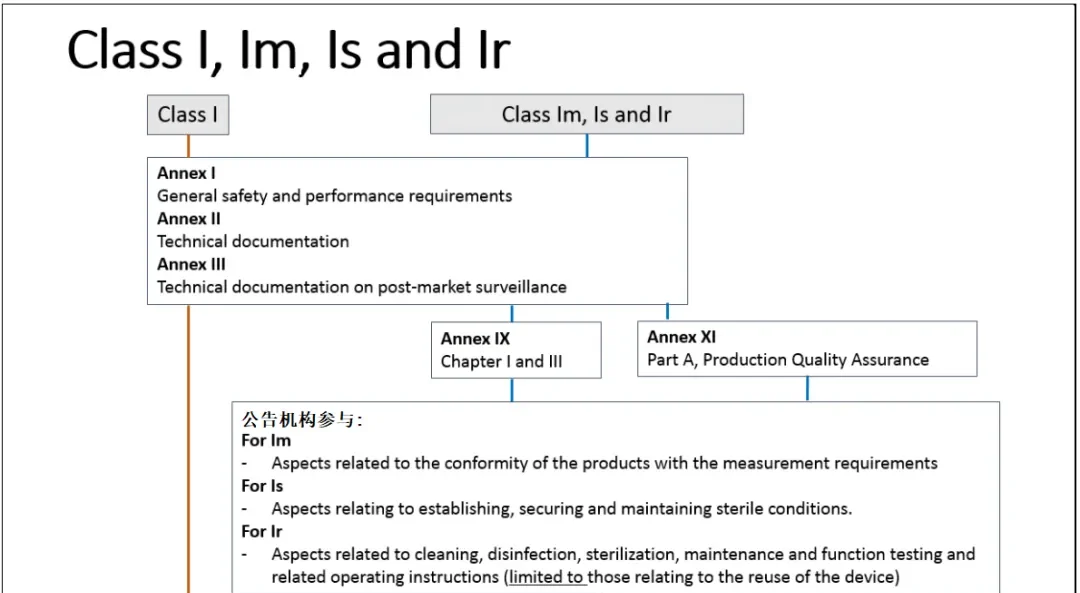
Conformity assessment for Class I
- Class I (standard): the manufacturer draws up the technical documentation (Annexes II and III), declares conformity in the EU declaration of conformity (Article 19 and Annex IV) and affixes the CE mark without a notified body.
- Class Is (sterile), Im (measuring function) and Ir (reusable surgical instruments): in addition, a notified body must be involved, limited to the respective aspects – sterility, metrology or reprocessing – via Annex IX Chapters I and III or Annex XI Part A.
The legal text of Article 19, Annex IV and Annex IX can be found in the MDR on EUR-Lex.
How EVERBIZ can help
EVERBIZ reviews the classification of your device, prepares Class I technical documentation and declarations of conformity, and acts as your EU authorised representative. Contact us for a classification check.
This article is for general information only and does not constitute legal advice. The official EU legal texts and MDCG 2021-24 on classification are authoritative.