
EVERBIZ | Original compilation. Please credit the source when republishing.
Summary
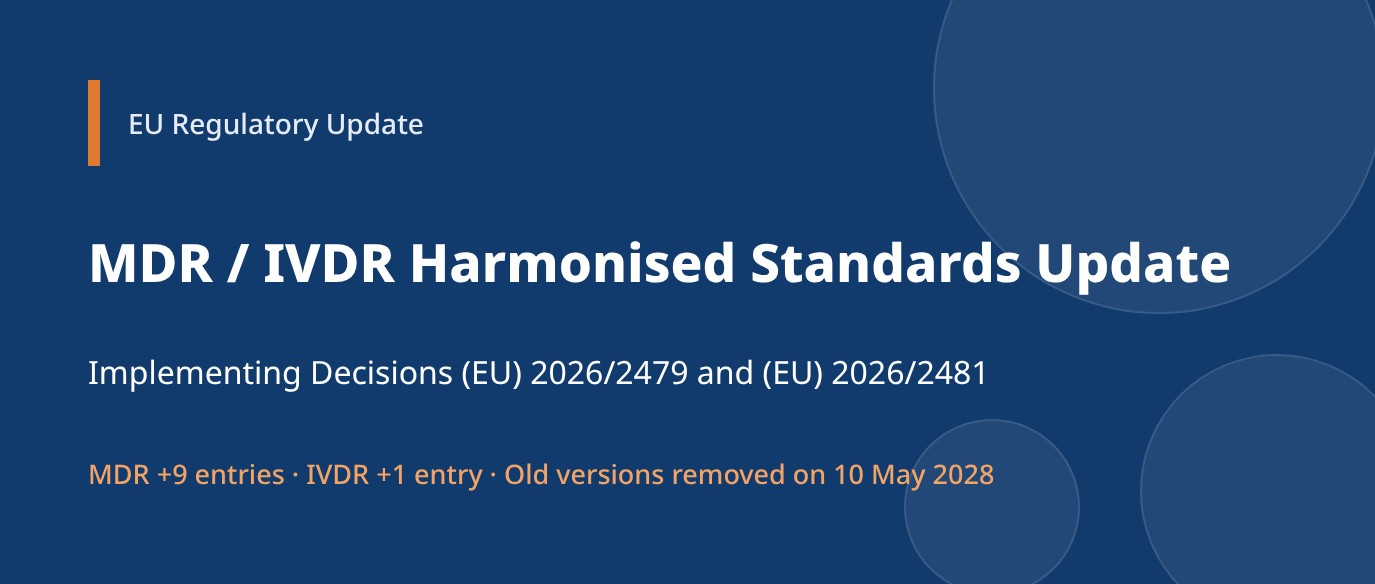
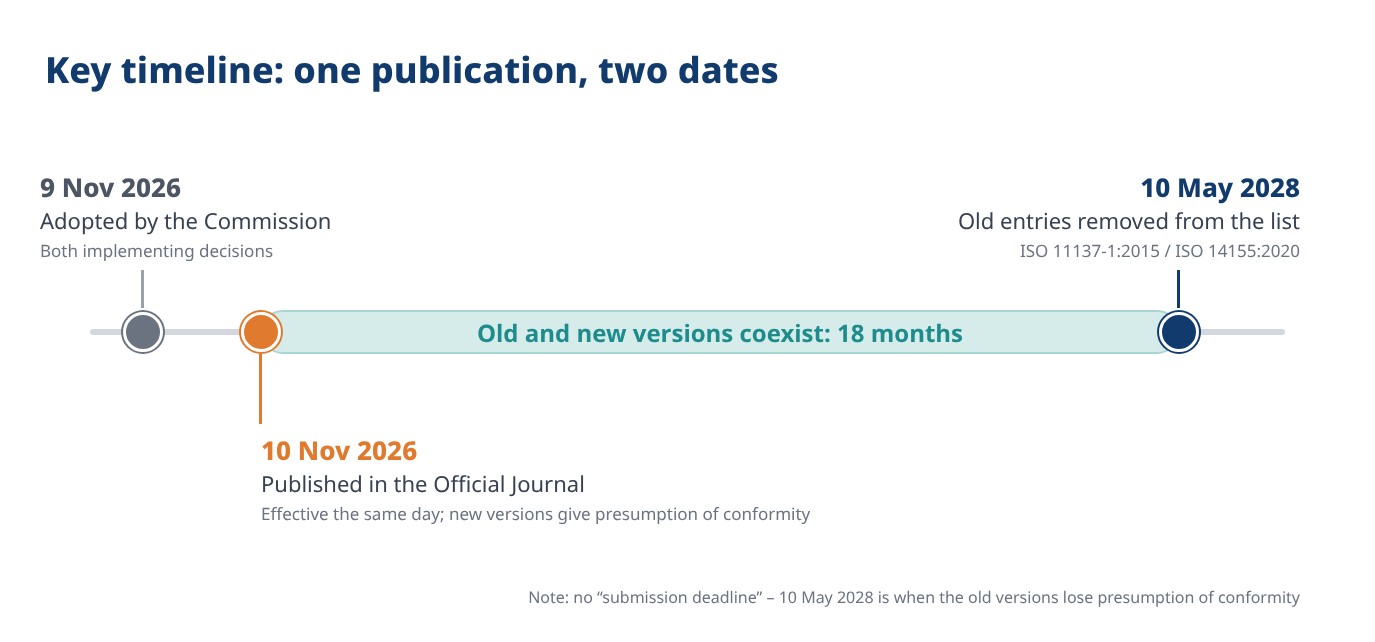
On 10 November 2026, the EU published two Commission Implementing Decisions in the Official Journal: (EU) 2026/2479 (for the MDR) and (EU) 2026/2481 (for the IVDR), updating the lists of harmonised standards under both regulations. Both decisions were adopted on 9 November and published and entered into force on 10 November.
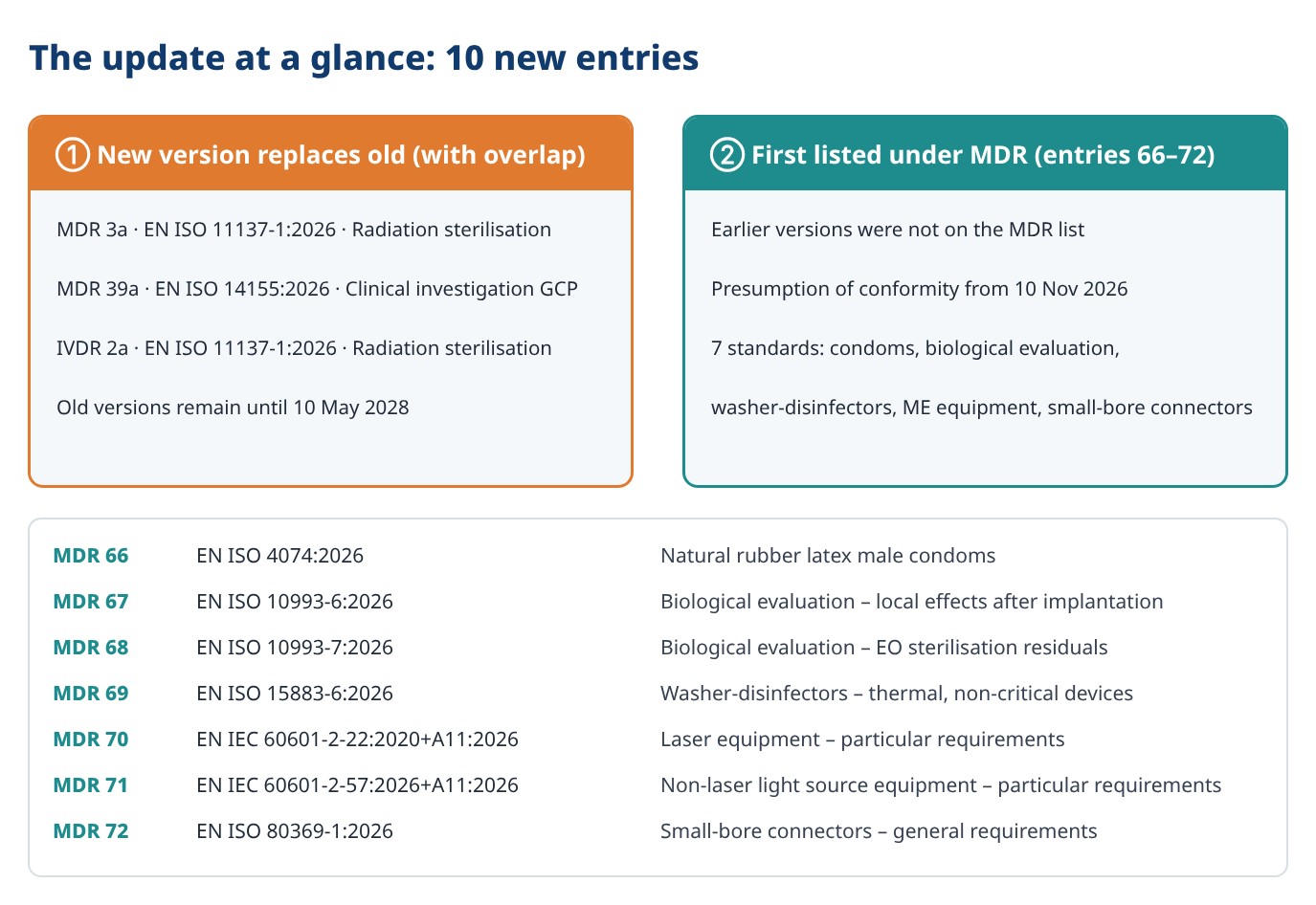
The update adds 10 entries in total: 9 under the MDR and 1 under the IVDR. Radiation sterilisation (ISO 11137-1) and clinical investigation (ISO 14155) are “new version replaces old version” cases; the old entries remain until 10 May 2028, giving an 18-month transition period. The other 7 standards are listed under the MDR for the first time.
To be clear: this update has no “submission deadline”, and companies do not need to submit anything to any authority. 10 May 2028 is the date on which the old versions lose their presumption of conformity – not a deadline for submitting documents.
Key dates at a glance
Concept: what is a “harmonised standard”?
The MDR and IVDR set out a large number of general safety and performance requirements (GSPR), but the regulations themselves do not specify exactly how to test or to what level. That is where standards come in.
A harmonised standard is a standard developed by the European standardisation organisations (CEN/CENELEC) at the request of the European Commission and formally referenced by the EU in the Official Journal. If a manufacturer applies such a standard, and the standard covers the relevant requirements, the device is presumed to conform to those requirements – the so-called “presumption of conformity”.
As an analogy: the regulation is the “exam syllabus”, and harmonised standards are the “officially recognised model answers”. Answer with the model answer and the examiner (the notified body) assumes you are right; you may answer differently, but then you have to prove that your answer is equally correct – which takes much more effort.
Key points: harmonised standards are voluntary; however, only standards listed in the Official Journal carry the legal effect of presumption of conformity. So each time the list is updated, it is worth re-checking the standard versions cited in your technical documentation.
What has changed?
Group 1: New version replaces old version (with an 18-month overlap)
| Regulation | Old entry (deleted on 10 May 2028) | New entry (effective 10 November 2026) | Subject |
|---|---|---|---|
| MDR | Entry 3: EN ISO 11137-1:2015 and A2:2019 | Entry 3a: EN ISO 11137-1:2026 (ISO 11137-1:2025) | Radiation sterilisation, Part 1 |
| MDR | Entry 39: EN ISO 14155:2020 and A11:2024 | Entry 39a: EN ISO 14155:2026 (ISO 14155:2026) | Clinical investigation GCP |
| IVDR | Entry 2: EN ISO 11137-1:2015 and A2:2019 | Entry 2a: EN ISO 11137-1:2026 (ISO 11137-1:2025) | Radiation sterilisation, Part 1 |
Until 10 May 2028, both old and new versions are on the list, and either version provides a presumption of conformity. In the recitals of the decisions, the EU explains that the old versions are deleted later to give manufacturers and economic operators enough time to adapt their processes and products.
One detail is worth noting: amendment A11:2024 to EN ISO 14155:2020 was only added to the MDR list in January 2026 by Decision (EU) 2026/193 – and less than a year later a new version has arrived. Companies planning clinical investigations that may run beyond May 2028 should confirm early which version their protocols and documents refer to.

Group 2: 7 standards listed under the MDR for the first time (entries 66–72)
Earlier versions of these 7 standards were not on the MDR harmonised standards list. The new versions have now been listed directly and can be used for presumption of conformity from 10 November 2026.
| Entry | Standard | Content |
|---|---|---|
| 66 | EN ISO 4074:2026 | Natural rubber latex male condoms – Requirements and test methods |
| 67 | EN ISO 10993-6:2026 | Biological evaluation of medical devices – Part 6: Tests for local effects after implantation |
| 68 | EN ISO 10993-7:2026 | Biological evaluation of medical devices – Part 7: Ethylene oxide sterilisation residuals |
| 69 | EN ISO 15883-6:2026 | Washer-disinfectors – Part 6: Washer-disinfectors employing thermal disinfection for non-critical medical devices and healthcare equipment |
| 70 | EN IEC 60601-2-22:2020 + A11:2026 | Particular requirements for basic safety and essential performance of surgical, cosmetic, therapeutic and diagnostic laser equipment |
| 71 | EN IEC 60601-2-57:2026 + A11:2026 | Particular requirements for non-laser light source equipment intended for therapeutic, diagnostic, monitoring and cosmetic/aesthetic use |
| 72 | EN ISO 80369-1:2026 (ISO 80369-1:2025) | Small-bore connectors for liquids and gases in healthcare applications – Part 1: General requirements |
The impact is broad: almost every ethylene-oxide-sterilised product is affected by 10993-7, implants by 10993-6, infusion, anaesthesia and respiratory products commonly use 80369-1 connectors, and laser and light therapy equipment is affected by 60601-2-22 and 60601-2-57.
Frequently asked questions
Q1: My technical documentation cites the old version. Do I have to change it immediately?
For the replaced standards (11137-1, 14155), the old versions remain on the list until 10 May 2028, so no immediate change is needed – but gap assessments should be planned early. For the 7 newly listed standards, the old versions were never on the MDR list, so this update does not make existing documentation “suddenly non-compliant”. However, the new versions are now a weightier reference and are likely to come up at your next technical documentation update or notified body audit.
Q2: Only the year in the version number changed – the content should be about the same, right?
You can’t assume that. The Official Journal only publishes the standard number, version and dates; the actual changes are in the text of the standard. The safer approach is a gap analysis for each standard, confirming that your existing test data and process validations still cover the new requirements.
Q3: How does this relate to other list updates this year?
The MDR and IVDR harmonised standards lists are based on the two original 2021 decisions, (EU) 2021/1182 and (EU) 2021/1195, which are continually “patched”. Each amendment may carry its own deletion dates for old versions. For example, another MDR decision in June this year, (EU) 2026/1231, set different transition dates. We recommend keeping a register by “standard – entry – deletion date” so that dates from different batches are not mixed up.
How should manufacturers respond?
- Radiation sterilisation: coordinate the MDR and IVDR tracks. If the same gamma or electron-beam sterilisation line serves both MDR and IVDR products, the sterilisation process can be assessed once against EN ISO 11137-1:2026, with applicability to each product family documented separately – completed before 10 May 2028.
- Planned clinical investigations: decide on the version first. For MDR clinical investigations that will span the transition period, confirm early which version of ISO 14155 the protocol, informed consent and monitoring documents follow, and assess the impact of the old version being removed from the list.
- Update GSPR checklists and technical documentation. For products involving ISO 4074, 10993-6, 10993-7, 15883-6, IEC 60601-2-22, 60601-2-57 or ISO 80369-1, we recommend a gap assessment against the new versions, followed by updates to the MDR Annex I GSPR checklist and technical documentation.
- Set up a standards monitoring process. The EU harmonised standards lists are updated frequently. We recommend regularly checking the European Commission’s harmonised standards pages and the consolidated lists on EUR-Lex, rather than discovering outdated versions during a notified body audit.
EVERBIZ continuously tracks global medical device regulatory developments. If you have questions about EU MDR/IVDR, FDA or Southeast Asian registrations, please contact us.