
EVERBIZ | Original compilation. Please credit the source when republishing.
On 29 October 2026, the Medical Device Division (MDD) of Hong Kong’s Department of Health published a new edition of its List of Recognised Standards for Medical Devices, RS-01:2026(E), effective the same day. It is the first revision of the list since May 2021.
The most notable change: a new Section 3.9 “Artificial Intelligence” with 12 standards, 10 of which are Chinese pharmaceutical industry standards (YY/T).
Some recent reports have described the update as having a “deadline” or requiring updates “within a transition period”. We checked the official MDD notices and the RS-01 text to clarify what changed, when it took effect, whether there is any deadline, and what it means for MDACS listing applications already submitted or in preparation.
1. Getting the dates right
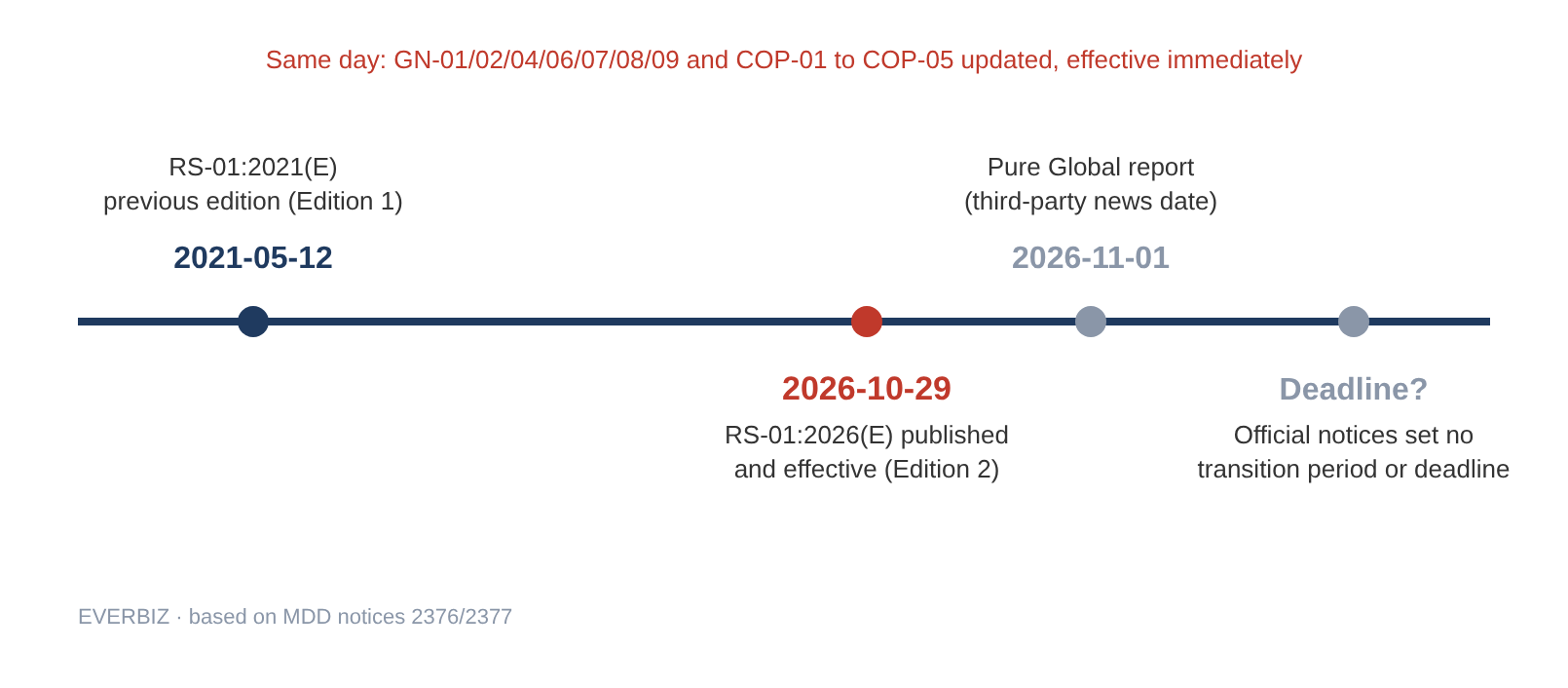
Many republished reports mix up the report date, publication date and effective date. Based on the official MDD documents:
| Date | Type | Details |
|---|---|---|
| 2021-05-12 | Previous revision | RS-01:2021(E) (Edition 1): format updated, division renamed “Medical Device Division”, standards list updated |
| 2026-10-29 | Publication = effective date | MDD notice (No. 2376) publishes RS-01:2026(E) (Edition 2), stating it is “effective from 29 October 2026” |
| 2026-10-29 | Related updates the same day | Guidance notes GN-01/02/04/06/07/08/09 and codes of practice COP-01 to COP-05 updated and effective immediately (notice No. 2377) |
| 2026-11-01 | Third-party report | English-language report by Pure Global (index date of a news platform, not an official date) |
| — | Deadline | Neither the official notices nor the RS-01 text set a transition period or deadline |
Note: “No deadline” does not mean “no action needed”. The RS-01 introduction requires the selected standards to reflect the state of the art at the time the Essential Principles Conformity Checklist is prepared. Applications submitted after 29 October should therefore, in principle, cite standards against the new list.
2. What changed?
The revision record of RS-01:2026(E) lists three changes:
- Updated standards list: newer editions now appear, such as ISO 10993-1:2025 and ISO 14155:2026. The revision record does not itemise which entries were added, updated or removed, so manufacturers need to compare the list against the 2021 edition themselves.
- Revised introduction (Section 1.1): clarifies the rules for citing standards (see Section 3 below).
- New Section 3.9 “Artificial Intelligence”: 12 standards, listed below.
The 12 standards in Section 3.9 “Artificial Intelligence”
| Standard | Subject (summary) |
|---|---|
| ISO/IEC 22989:2022 | AI concepts and terminology |
| ISO/IEC 23053:2022 | Framework for AI systems using machine learning |
| YY/T 1833.1-2022 | AI medical devices – quality requirements and evaluation: terminology |
| YY/T 1833.2-2022 | General requirements for datasets |
| YY/T 1833.3-2022 | General requirements for data annotation |
| YY/T 1833.4-2023 | Traceability |
| YY/T 1833.5-2024 | Pre-trained models |
| YY/T 1858-2022 | Lung imaging analysis software – algorithm performance testing |
| YY/T 1907-2023 | Coronary CT image processing software – algorithm performance testing |
| YY/T 1949-2024 | Diabetic retinopathy colour fundus photographs – dataset requirements |
| YY/T 1990-2025 | Cytopathology image analysis software – algorithm performance testing |
| YY/T 1991-2025 | Stroke CT image analysis software – algorithm performance testing |
Note: subjects are EVERBIZ summaries (YY/T titles translated from Chinese). Refer to the RS-01:2026(E) text for full titles.
3. What does the revised introduction say?
Revised Section 1.1 contains several provisions that directly affect application documents:
- State the edition: cited harmonised and international standards must include the specific year of publication or version number.
- State of the art applies: selected standards should reflect the state of the art when the Essential Principles Conformity Checklist is prepared; if an older edition is used, a justification is required.
- Other evidence is accepted: recognised standards may not cover every requirement (especially for novel devices), so other documentary evidence, including industry or company standards, can be submitted for MDD assessment.
- Conforming to standards is not full compliance: meeting some standards may not be enough to demonstrate full conformity with the Essential Principles (TR-004).
- MDACS only: the list applies only to MDACS. Where other Hong Kong legislation applies, manufacturers and Local Responsible Persons (LRPs) must follow the relevant standards separately and consult the competent authorities.
4. What does this mean for Chinese manufacturers?
Official fact: 10 YY/T AI standards are now on the Hong Kong MDACS list of recognised standards.
EVERBIZ view: AI software that has already completed Chinese registration testing against these YY/T standards (for example lung nodule, coronary CT, fundus, pathology or stroke imaging analysis) can cite them directly in a Hong Kong listing application, giving more room to reuse existing test evidence. However, being on the list only means a standard “can be cited”. It does not mean NMPA registration documents or test reports are accepted automatically; the MDD still assesses each Essential Principle.
Cybersecurity and software standards also deserve attention: Section 3.8 “Software” lists IEC 62304, IEC 81001-5-1, ISO/IEC 27001 and others, which AI software will usually need to cite together with Section 3.9.
5. What about applications already submitted or in preparation?
- Applications already submitted via MDIS: MDD notice 2377 states that the GN/COP updates do not affect listing applications already submitted, and no resubmission is needed. Note that this statement refers to the GN/COP updates; the RS-01 notice (2376) says nothing about applications under review.
- Applications submitted after 29 October: we recommend citing standards against RS-01:2026(E) and stating the edition; if an older edition is used, explain why in the checklist.
- Devices already listed: no immediate update is required. We recommend reviewing the editions of cited standards at the next change, renewal or MDD enquiry.
6. What to do now
- Step 1 | Compare the list: check the standards currently used for your product against RS-01:2026(E) and mark those with new editions or newly applicable entries.
- Step 2 | Review AI products: for software with AI functions, confirm which YY/T and ISO/IEC standards in Section 3.9 can be cited, and organise Chinese test reports and dataset documentation.
- Step 3 | Update the checklist: state the year/edition of each standard in the Essential Principles Conformity Checklist; where an older edition is kept, add a gap analysis or justification.
- Step 4 | Align with the new guidance: GN-01, GN-02, GN-06, COP-01 and other documents were updated the same day; check the latest versions before applying.
How EVERBIZ Can Help
The revision sets no deadline, but the new list is already in effect. EVERBIZ can help you map your standards against RS-01:2026(E), update your Essential Principles Conformity Checklist and assess how Chinese YY/T test data can be used in a Hong Kong listing. Contact us for an assessment of your product.
This article is a compilation of regulatory information and does not constitute legal advice. The official MDD documents prevail.
EVERBIZ | Original compilation. Please credit the source when republishing.